
The Hidden Cost of Keeping Your Options Open

What Are You Waiting For?
There's a piece of career advice that sounds like wisdom and often isn't.
Keep your options open. Don't close doors you might need later. Wait for clarity before you commit.
I've given this advice more times than I can count. In coaching sessions, in conversations, in my newsletter, and I stand by the instinct behind it. Rushing into irreversible decisions without enough information is a real risk.
However, I had a moment recently, mid-session with a coachee, where I heard myself giving this advice and realised it wasn't helping. They weren't stuck because they lacked information. They weren't stuck because the decision was genuinely complex. They were stuck because nothing was forcing them to choose, and my advice was making that comfortable.
I was giving them permission to wait and the waiting had become the problem.
That realisation shifted something for me. The advice isn't wrong. It's incomplete. The gap between the advice and the full picture is where a lot of careers quietly stall.
Last week's newsletter explored the brutal test for career decisions: does this make you stronger in 12 months, or just more comfortable today?
This week, I am one layer deeper. Even when you know what the right decision is, there's another trap waiting.
It's disguised as patience.
Why "Keeping Options Open" Feels So Safe
Optionality has become a career religion. In a world that changes fast, flexibility feels like protection. Committing too early to the wrong thing has real costs.
So you wait and gather more information. You stay open to what might emerge.
That's not a bad instinct. The problem is that it has no natural endpoint. Nobody taps you on the shoulder and says: right, clarity has arrived, time to decide. Some career decisions don't come with deadlines. They just sit there, open-ended, for as long as you let them.
Patience without a plan isn't strategy. It's just waiting, with better branding.
Ideas. Growth. Clarity. Sent every Monday.
The Real Price of Indefinite Optionality
Most people think the cost of delayed decisions is opportunity. You miss out on the thing you didn't choose. That's real. But it's not the biggest cost.
The bigger costs are more subtle.
First, there's the energy drain. Unmade decisions sit in the background of your thinking. They take up space. Every week you don't decide is another week that decision is quietly consuming mental bandwidth you could spend on something else.
Second, there's the signal you send. People who commit attract opportunity. They become legible. Others understand what they're about, what they're building toward, what they need. People who perpetually hedge are harder to help and harder to back. Colleagues, managers, and mentors tend to invest in people who've picked a direction.
Third, and this one is uncomfortable, indefinite optionality can become its own kind of identity. Being someone who "hasn't decided yet" starts to feel normal. The longer you wait, the more the waiting becomes the default state.
The Difference Between Smart Patience and Comfortable Avoidance
This is the distinction that matters most.
Patience can be strategic when it has an endpoint. Holding off while you gather specific information. Waiting for a real signal before you commit. You know what you're waiting for.
Most people don't reach that point. They live with an open-ended "not now" that quietly becomes the default. No deadline. No trigger. Just hovering, and it looks responsible from the outside. Considered. Not rushing.
Meanwhile, nothing moves. The test is simple:
What would have to be true for you to decide?
If you can answer that question clearly, you're being strategic. You're waiting for something real.
If the answer keeps shifting, or there is no answer, you're not waiting for a signal. You're avoiding the discomfort of choosing.
Clarity rarely arrives fully formed. More often, it emerges through deciding, not before it.
How to Build Your Own Forcing Function
If no external deadline is going to make you choose, create one yourself. This isn't about being reckless. It's about being honest that open-ended waiting has a cost.
Here's a simple framework:
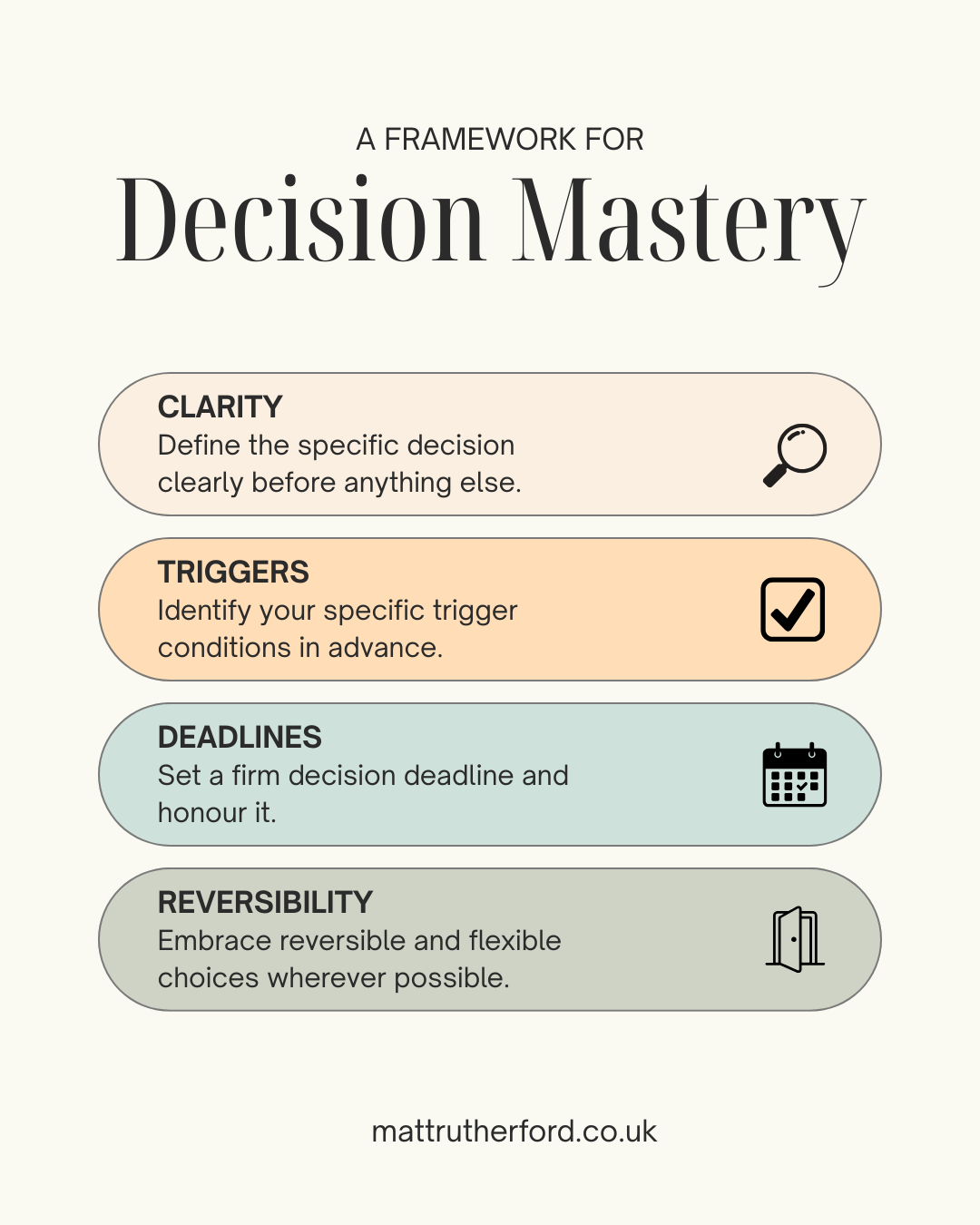
- Name the decision clearly. Vague decisions stay unmade. "Should I think about maybe exploring a move into a different area" is not a decision. "Should I apply for the product role at [company] before the end of Q1" is.
- Define your trigger condition. What specific thing would make you say yes? What would make you say no? Write it down. If you cannot, that's useful information.
- Set a real deadline. Not "soon." A date. By that date, you'll have gathered what you need and you'll decide. If new information arrives before then, great. If not, you decide with what you have.
- Treat the decision as reversible where it actually is. Most career decisions aren't as permanent as they feel. Taking a new role isn't irreversible. Asking for a different kind of project isn't irreversible. Clarifying what's reversible reduces the psychological weight of deciding.
This isn't about forcing bad decisions quickly. It's about preventing good decisions from dying through indefinite delay.
Ideas. Growth. Clarity. Sent every Monday.
But Matt, What If I Get It Wrong?
The fear behind most delayed decisions isn't really about needing more information. It's about being wrong.
If you don't decide, you can't be wrong. You're still in the consideration phase. Still open. Still thoughtful.
Not deciding is itself a decision. It's a vote for standing still. The status quo has its own risks, they're just less visible because nothing dramatic happened.
The question isn't whether you might get it wrong. You might. The question is whether the cost of being wrong is recoverable, and whether the cost of waiting is lower than you think it is.
Most of the time, the answer to both is yes.
You can read more about how to think through high-stakes career decisions here.
One Thing to Do This Week
Identify one decision you've been 'keeping open' for more than three months.
Ask yourself
What would have to be true for me to decide?
If you can answer it, go and get that information. If you can't, the decision is probably already made.
You're just not ready to say it out loud yet.
Either way, name it. That's where it starts.


Member discussion