
You already had them


You turned down a role with a better title and more money. You decided that your weekends were protected, and the laptop does not come home. You were angrier than the situation deserved when somebody else took credit for your work.
These are not three separate events. They are one thing showing up three times.
You did not weigh any of them up from scratch. Something decided them for you, and it has been doing that for years.
The pattern was running before you named it
Values aren't found. They are recognised.
You have been operating on a consistent set of priorities for years, and what is often missing is the name, not the behaviour.
That's why writing them down can feel like they came out of the blue.
The surprise is recognition. New information about something you have always done.
When I did my values work with a coach for the first time, I was surprised to see fairness sitting so high. I had never thought of myself as a champion of justice.
My coach asked me to play back some recent decisions and how I had acted in them. I could see clear examples where I had made things trickier for myself by working with fairness in mind.
It was not an idea I held. It was already showing up in how I worked.
The naming gives you something on its own. A label for the way you approach the big parts of your life, and some relief that it is a way rather than an accident.
Why the poster never worked
The usual version is aspirational.
Pick the values you want to have, then try to live up to them. That produces a list describing somebody else, and a constant sense of failing it. Productivity earns no place on your list if you have no intention of optimising anything.
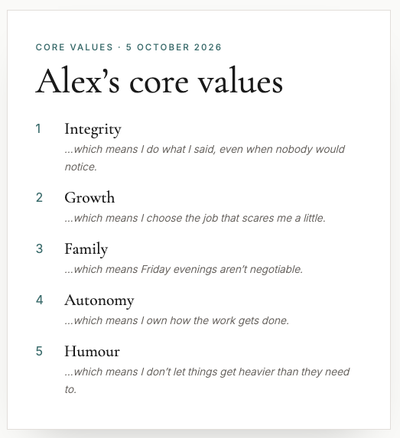
The Values Finder starts from the opposite instruction: tap the ones that feel true of you, not the ones you think you should have.
The list that comes out is already in evidence, in your thinking and in the decisions you have already made.
You can skip all of this, and most people do. It costs you something. You make the same decision from scratch every time it arrives, and you cannot defend it to anybody, including yourself, when it gets challenged.
Three decisions, one theme
Take three decisions from the last five years that you still stand by. Not the biggest. The ones you would make again without hesitation. Ask what they have in common.
Then say that word out loud to somebody who was there for at least one of them, and ask whether it fits what they saw.
What were you protecting, every time?
The decisions were never random. Nobody had told you the name of the thing making them.


Member discussion