
Who is the machine working for?
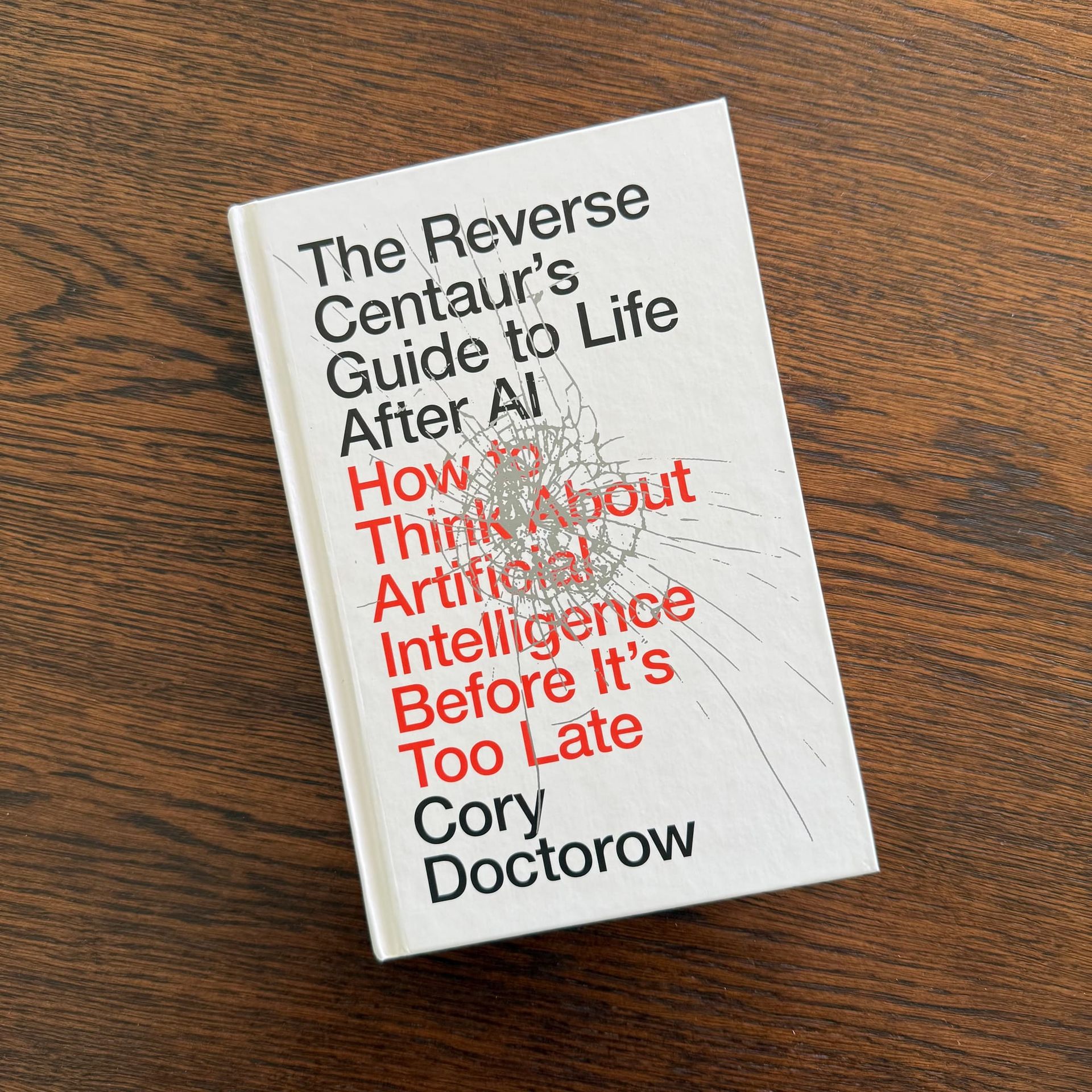
You've been handed a new AI tool at work. It drafts the reports now.
Your job is to read every one, catch what it gets wrong, and put your name at the bottom. The volume has tripled. The deadline hasn't moved. Somewhere along the way you stopped doing the work and started supervising a machine that does it badly.
Cory Doctorow has a name for you. A Reverse Centaur.
The Reverse Centaur's Guide to Life After AI skips the usual extremes of effortless abundance and mass obsolescence.
He looks at ordinary jobs and asks a plainer question. When the machine arrives, who ends up working for whom?
Head or body
The book hinges on a term from automation theory, with a nod to Greek myth. A centaur is a person assisted by a machine. You stay in control. The tool takes the friction out of the work and you point it at what matters.
A reverse centaur flips the idea. The human is conscripted into assisting the machine. The machine sets the pace and the human does the clean-up, at a speed nobody chose. Think of a radiologist reduced to signing off on whatever the software flagged, or a writer spending the day fixing plausible nonsense instead of thinking.
The human in that loop has one more job. When the machine gets it wrong, someone has to carry the blame, and it won't be the machine. You're not there for your judgement. You're there as an accountability sink.
The real fight over AI at work is which of the two you get to be.
Three ideas that stuck
- The hype. AI companies need enormous claims to justify enormous valuations. Doctorow is clear that we're in a bubble, with the same money passing between a handful of companies and counted as revenue by each. Treating the tools as magic stops you counting what they cost you in attention. I'd add one observation of my own. It's no coincidence that the doomsday warnings about frontier models are getting louder as the big AI companies move toward IPOs.
- Agency rather than output. Ask who directs your day. A tool should free up your attention, not turn you into a supervisor for clumsy software. If AI isn't making space for you to think or create, it's time to take stock.
- The aftermath. Doctorow compares this moment to the dot-com crash, which wiped out fortunes and still left useful technology behind. Every bubble bursts. The question worth asking now is which tools will still earn their place in your work once the noise fades.
What he wants us to do about it
Doctorow isn't suggesting we abandon automation. He talks about his own use of these tools, and he's genuine about the good ones: transcription, translation, taking the drudge work off artists. What he asks is that you protect your attention and refuse to become cheap padding for imperfect algorithms.
Towards the end he takes on the fix most creative people reach for first. More copyright, he argues, mostly benefits the big rights holders rather than the people doing the work. He puts his faith in labour power instead, and points to the 2023 Hollywood writers' strike. The Writers Guild won the right to be centaurs. Studios can't force writers to use AI, and AI-generated material can't be used to undercut their credit or pay.
Where I didn't fully agree
Doctorow is sharp and funny throughout. I found that energising, and his examples made me rethink several things I thought I'd settled. He's less sceptical than someone like Ed Zitron, though, and it shows.
When he gets to AI as a therapist or a creative helper, he's more relaxed than I am. Those are the uses where the reverse centaur question matters most, because the thing being handed over is your own thinking. On those, the book steps around the debate rather than settling it.
It still helped me think about my own relationship with AI and where I sit in the balance.
That alone made it a valuable read.
Who it's for
Read it if you're being told to "just use the AI" at work. Read it if you're a manager rolling out AI tools and you don't want to turn your team into reverse centaurs.
Read it if you're sceptical of both the hype and the doom.
Where I've landed
I've sat with the book for a couple of weeks, and I've asked myself more than once whether I'm the head or the body. I mostly use AI as a project manager, to keep me on track, or as technical support, to guide me through processes I need clarity on.
I'm deliberately cutting back anything that feels like creative input from a model.
When AI looks like the answer to a challenge, I now ask myself one question:
What am I outsourcing, and what am I abdicating?

Member discussion