
How to Save the Internet by Nick Clegg
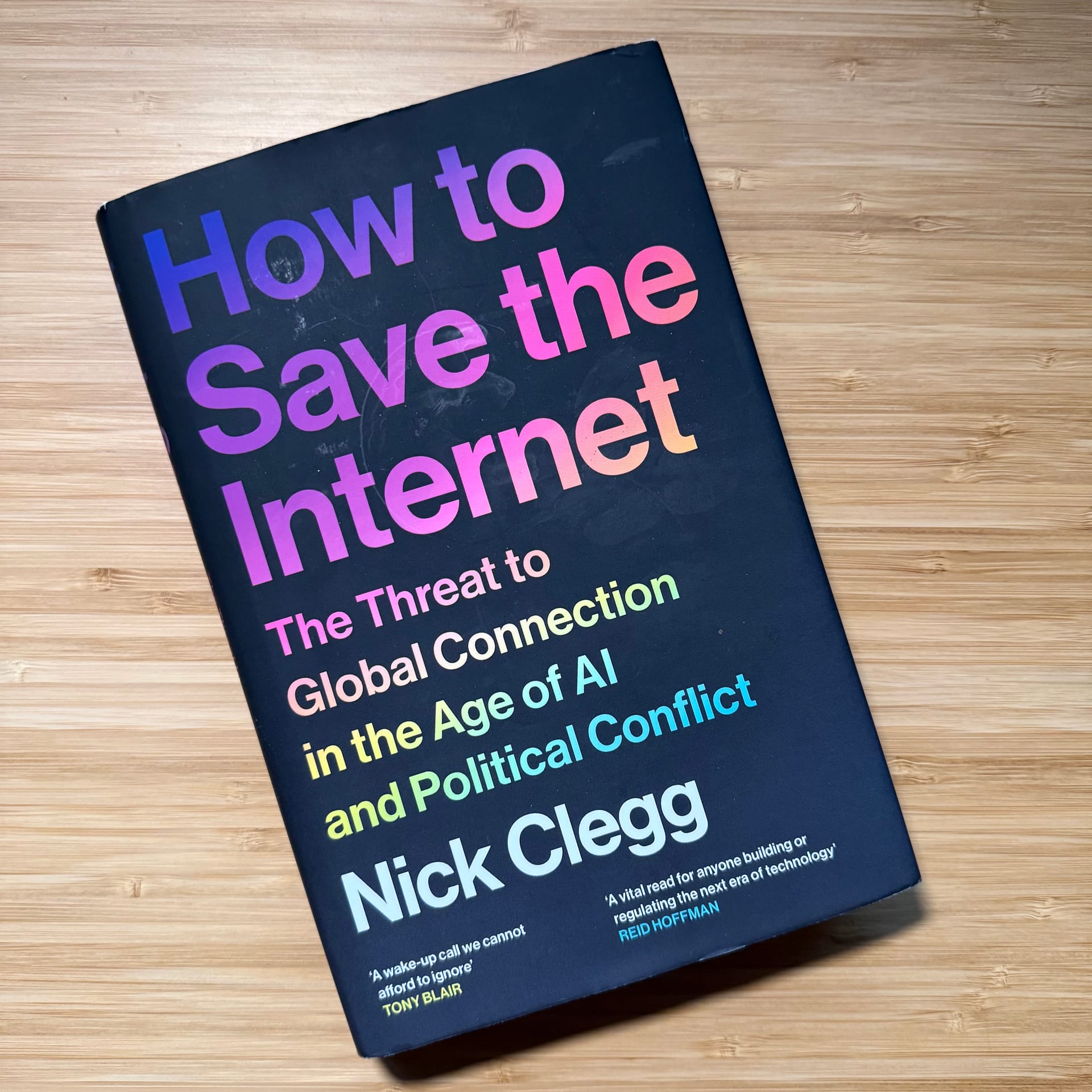
My old boss (sort of) has written a book about the internet. It took me a while to get through it, and I found it an engaging read that has some interesting ideas about the way forward for the Internet in the age of AI.
Can the Internet Still Be Saved?
Nick Clegg thinks so. How to Save the Internet makes a case for it, while raising hard questions about power, trust, and who really controls the digital world most of us depend on every day (some of us for a living).
This is (unsuprisingly) a politically founded argument. The problems Clegg discusses are not about code or bandwidth.
They are about governance, incentives, and accountability.
The internet, he argues, is not failing because the technology broke. It is failing because the systems around it never caught up.
Why this book exists
Clegg opens with a blunt diagnosis. The internet is under strain from all sides. Governments want more control. Platforms face rising public anger. Citizens no longer trust what they see online. AI accelerates every existing problem.
The original promise of a single, open, global network is more fragile now. Clegg describes one future path where that network fractures into national or regional versions, each shaped by local politics and rules.
If that happens, the internet stops being truly global. It becomes a patchwork of connected but incompatible systems.
It's easy to imagine how this change would affect how you work, learn, and connect.
Many of the freedoms people now take for granted depend on openness and interoperability. Remove those, and the internet becomes narrower, slower, and more controlled.
The risk of a splintered internet
Fragmentation is at the heart of the argument. Clegg warns that governments are trying to impose traditional ideas of sovereignty onto a system that was never designed to respect borders.
We can already see this happening through data localisation laws, national content rules, platform bans, and region-specific AI regulation.
Each policy may look reasonable in isolation. Together, they pull the internet apart.
The book is clear on the danger. Regulate the internet as if it were a national utility and you destroy what made it powerful.
Speed, scale, and global reach do not survive heavy, uncoordinated regulation. Interoperability disappears first, and everything else follows.
Big Tech’s credibility problem
Clegg does not pretend technology companies are innocent.
There is acceptance that platforms created many of their own problems through secrecy, overconfidence, and slow responses to real harm.
Decisions that shaped public discourse were often made behind closed doors. Algorithms influenced attention without explanation. Appeals processes were opaque or inconsistent. Over time, trust collapsed.
Where Clegg pushes back is on the idea that these failures prove malicious intent. His view is that the bigger issue was institutional immaturity. Platforms grew faster than their ability to govern themselves, and the gap showed.
This argument will frustrate some readers.
It falls between two sides of an argument. One says platforms are villains that must be broken up. The other says platforms are neutral tools and society should adapt. The book rejects both and argues for responsibility without demonisation.
Transparency as a starting point
The book becomes more practical when it turns to solutions. The central proposal is radical transparency.
Clegg proposes that platforms must explain how their systems work in ways that are intelligible and testable. That means clearer disclosure about how content is ranked, how moderation decisions are made, and how appeals are handled. It also means admitting trade-offs instead of hiding behind vague statements.
This is not 'just' publishing source code. It's real accountability. If systems influence millions of lives, secrecy is no longer a defensible stance.
Most people do not accept opaque or fuzzy decision-making from employers or public institutions. Clegg asks why platforms should be held to a lower standard.
Who should hold the power
Another fault line runs through the book. Too much authority over online speech sits with too few people.
Today, global content decisions are often made by small groups of executives, legal teams managing risk, or policy staff under constant pressure. Clegg argues that no private company should act as the final authority on what billions of people can say or see.
His answer is shared governance. He points to independent oversight bodies as an early step, not a final solution. The deeper principle is that decision-making should reflect the diversity of users affected.
Rules that shape global speech should not be set in a single headquarters or legal jurisdiction. Culture, context, and consequence matter. Ignoring that reality creates resentment and error at scale.
Regulation without destruction
Clegg’s position on regulation is complex and nuanced. He does not argue against it. He argues against over-simplistic rules written without technical understanding.
Good regulation, in his view, should protect users while preserving openness. It should encourage competition rather than entrench incumbents. Most of all, it should avoid fragmenting the internet.
The pattern he warns against is familiar. A crisis erupts. Political pressure builds. A law follows quickly. Little attention is paid to long-term consequences or system-wide effects. Current news cycles follow this pattern regularly.
The books challenge is straightforward. Regulate harmful behaviour. Do not confuse political borders with digital infrastructure.
Why global cooperation matters
The most ambitious part of the book is also the most uncertain. Clegg argues that no country can govern the internet alone. Not the United States. Not the European Union. Not China.
The internet’s architecture is global. Its governance must reflect that reality. Clegg proposes an alliance of digital democracies built around shared principles such as freedom of expression, data protection, open markets, and rule of law.
This would not eliminate disagreement. It would create the conditions for some alignment. Without it, authoritarian models of control gain ground simply because they scale faster.
If your work depends on open access to information, this should concern you. Control travels easily across borders. Freedom requires coordination.
AI raises the stakes
Clegg treats AI as an accelerant rather than a separate issue. Algorithms already shape attention. AI amplifies that influence while making systems harder to understand.
More automation means fewer clear lines of responsibility. When outcomes become opaque, accountability weakens. Clegg argues that AI governance must avoid repeating the mistakes made with social media.
Auditability, oversight, and human responsibility become more urgent, not less. The question is not whether AI will shape the internet. It already does. The question is whether that power will remain visible and contestable.
Where the argument falls short
The book is not without blind spots. Clegg underplays the role of advertising incentives and attention-driven business models. Transparency alone may not change behaviour if revenue depends on engagement at any cost.
There is also a gap between vision and execution. Global treaties sound compelling but are difficult to enforce. Oversight bodies help, but they struggle at scale. These weaknesses are real and unresolved. The current global landscape is already showing this gap in reality.
Clegg acknowledges some of this, but not all. The book defends platforms more than some readers will be comfortable with.
Conclusion
Despite its limitations, the book matters because of its perspective.
Clegg has operated inside government and inside one of the world’s most powerful technology companies.
That dual experience gives weight to the warnings.
He is not offering a utopia. He is arguing for realism. Power needs visibility. Governance needs to evolve.
If nothing changes, the internet will fragment by default. Control will harden. Decisions will concentrate further. That outcome is not inevitable, but avoiding it requires intent.
This book sharpens the debate.
If the open internet still matters to you, How to Save the Internet gives you a framework to think clearly about what comes next, and what you may lose if you assume someone else will fix it.
What would you be willing to give up to keep the internet open? And what happens if you do nothing?





Member discussion