
A door, not an answer
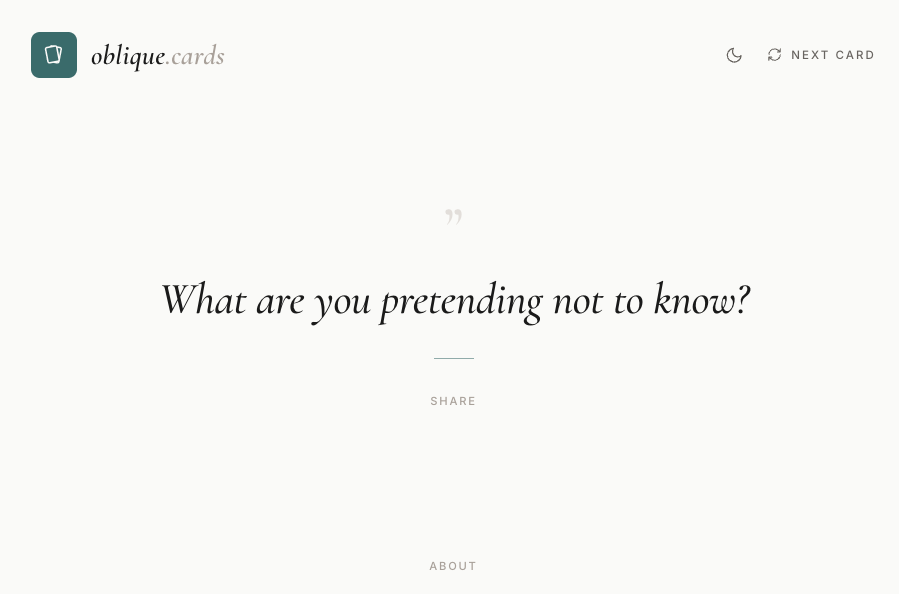
Most of my working time is spent asking people questions. As I pivot towards coaching for a living, the work is mostly one thing.
Helping someone see what they are standing too close to see.
This week I tried to put some of that into a deck of cards.
It is called oblique.cards. You draw one when you are stuck, on your work or your life, and it nudges you sideways. It began as a tribute to Brian Eno and Peter Schmidt's Oblique Strategies, the deck that creatives reach for when they hit a wall. I wanted my own, pointed at careers and lives instead of art.
The building was the easy part. One page, a small server, an afternoon of talking to an AI. The kind of thing that used to take weeks and a developer. I'm using the process as a way to teach myself, this new paradigm.
The harder part was the writing, I started with a hundred cards. One line I kept me stuck for a while.
Here it is. "Picture five more years of exactly this. Threat or promise?" The first sentence works. The second one ruins it. It answers the question for you. It tells you how to feel.
So I edited ruthlessly. "Picture five years of exactly this." Now it just sits there, and you have to do the work.
That is the whole discipline of the deck - it is also the whole discipline of coaching.
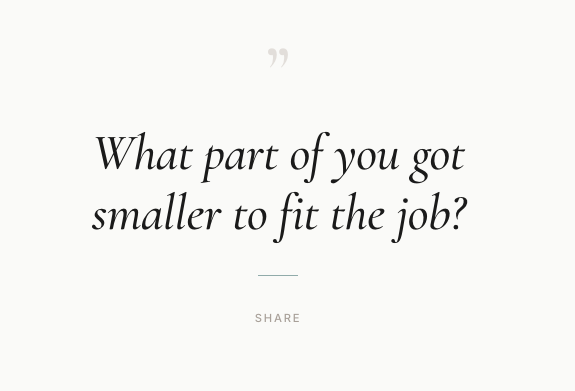
A good question does not hand you an answer. It moves your attention somewhere you were not looking, then gets out of the way. "Whose permission are you waiting for?" is not advice. It is a door. You walk through it or you do not, but nobody pushed.
Advice is the opposite. It arrives with the answer already attached, which is exactly why so much of it slides straight off. You have had the advice. Everyone stuck has had the advice. What you have not had is a question sharp enough to make your own answer move.
The temptation, writing the cards and sitting with clients both, is always to be helpful. To add the reassuring second sentence. To explain. Helpful is easy. The harder thing, and the useful one, is to say less and trust the person to finish it.
That trust is the job. In a card, in a coaching room, in any conversation that changes something. You are not short of information. You are short of the one question that turns you slightly, so the thing you could not see is suddenly in front of you.
The deck is just that discipline, made portable.
Draw a card at oblique.cards. See where it turns you.




Member discussion